
Open Field Test (OFT)
The Gold Standard for Assessing Anxiety-like Behaviors and Spontaneous Locomotor Activity
Introduction
The Open Field Test was established by Calvin S. Hall in 1934 as a classic behavioral paradigm. It is designed based on the "Approach-avoidance conflict" principle in rodents (rats and mice) when facing a novel environment: animals have an innate instinct to explore new environments (exploratory drive), but as prey animals, they also have an innate fear of open, bright, and unobstructed areas (avoidance instinct).
By observing the activity of animals in a closed square or circular open field, their spatiotemporal distribution in the "Safe Zone" (periphery/near walls) versus the "Threat Zone" (center area) can be quantified, thereby assessing the animal's spontaneous locomotor activity and anxiety-like behavior.
Purpose
Assess Anxiety Level
Judge anxiety levels by measuring the animal's willingness to enter and time spent in the center area (higher anxiety correlates with avoiding the center).
Assess Spontaneous Activity
Record total distance and speed to rule out motor dysfunction or sedative drug effects on behavior.
Screening & Phenotyping
Used for evaluating anxiolytic drug efficacy, identifying behavioral phenotypes in gene-edited animals, and assessing neuropsychiatric disease models.
Apparatus & Standard Dimensions
3.1 Open Field Arena
The arena material should be medical-grade ABS engineering plastic or acrylic. The surface must have a matte finish to prevent light reflection from interfering with video tracking. The color is usually chosen to form a high contrast with the animal's coat color (e.g., black arena for white mice, white or gray arena for black mice).
| Subject | Shape | Dimensions (L × W) | Wall Height | Center Zone Definition |
|---|---|---|---|---|
| Mouse | Square | 50 cm × 50 cm | 30 - 40 cm | 25% of total area (25cm × 25cm) |
| Rat | Square | 100 cm × 100 cm | 40 - 50 cm | 25% of total area (50cm × 50cm) |
3.2 Auxiliary Equipment
- Video Tracking:Overhead camera (IR recommended) connected to behavioral analysis software.
- Lighting:Adjustable LED source. Standard illuminance for anxiety tests is 100-400 Lux (no shadows in center); can be lowered to < 50 Lux if only testing locomotor activity.
- Cleaning:75% Alcohol (or 70% Ethanol) spray, disposable paper towels, odorless cleaning cloth.
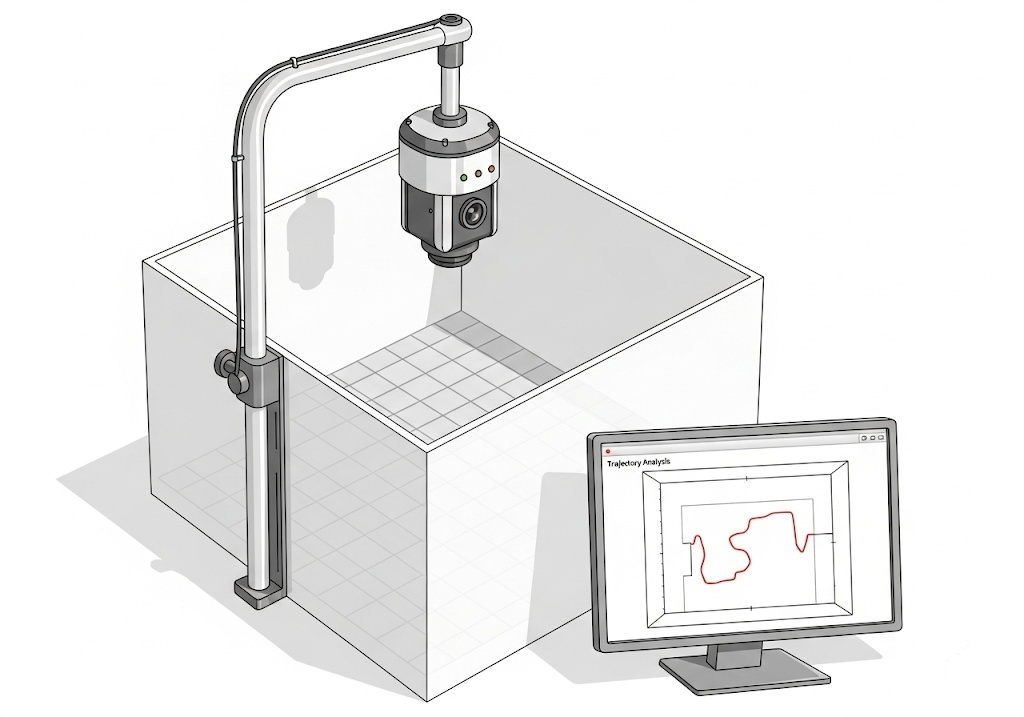
Pre-experimental Preparation
Acclimatization
- Transfer animals (in home cages) to the behavioral lab 30-60 minutes before testing.
- Keep environment quiet, light constant, and temperature at 22±1°C to allow adaptation and eliminate transport stress.
Environment Control
- Maintain silence. A white noise generator (~60dB) is recommended to mask sudden external noises.
- Experimenter should observe from a separate room or out of sight to avoid interference.
Equipment Check & Cleaning (Critical)
1. Turn on camera and software, calibrate background to ensure accurate tracking.
2. Thoroughly wipe the floor and walls with 75% alcohol to remove urine, feces, and scent cues (pheromones) from previous animals.
3. Wait 5-10 minutes after cleaning for alcohol to fully evaporate and the arena to dry before starting.
Procedure
1. Animal Placement
Wear gloves and handle animal gently. Place the animal facing away from the experimenter into the Center of the arena (some SOPs suggest corner placement, but center placement better elicits initial escape response for anxiety assessment).
Note: Placement position and orientation must be strictly consistent for all animals in the same batch.
2. Recording
Start recording immediately upon placement or within seconds. Standard test duration is usually 5 minutes (for anxiety) or 10 minutes (habituation assessment can be 10-30 mins).
3. Termination
Stop tracking after time ends. Remove animal and place in a clean cage or mark it; do not mix stressed animals with untested ones (to prevent stress odor transmission).
4. Cycling
Clean feces/urine, wipe with 75% alcohol, and ensure it is dry before testing the next animal.
Key Results & Interpretation
6.1 Anxiety-like Behaviors
Principle: High anxiety animals show strong "Thigmotaxis" (tendency to stay close to walls) and rarely enter the open center.
- Time in CenterMore Time = Lower Anxiety
Cumulative time spent in the center. Core metric for anxiolytic efficacy.
- Entries into CenterMore Entries = Lower Anxiety
Reflects initiative to overcome fear and explore.
- Latency to CenterShorter Time = Lower Anxiety
Time from start to first center entry. If never entered, latency = total time.
- Thigmotaxis IndexHigher Ratio = Higher Anxiety
Time spent in periphery (5-10cm from wall). High anxiety models may spend >90% time here.
6.2 Basic Locomotor Metrics
Principle: Assess general activity level; critical control to rule out sedation or motor deficits.
- Total Distance Moved
Total length of the movement trajectory.
Decrease: Motor deficit, sedation, sickness, or freezing.
Increase: Hyperactivity, stimulant effect.
Note: Must combine with center time. Low center time + Low distance could mean immobility, not just anxiety.
- Average Speed
Total distance divided by moving time (cm/s). Assess burst capability and physical condition.