
Morris Water Maze (MWM)
Standard Operating Procedure and Technical Report
1. Introduction & Theoretical Basis
1.1 Historical Background & Evolution
The Morris Water Maze is one of the most influential experimental paradigms in behavioral neuroscience, first designed and published by psychologist Richard Morris of the University of St Andrews in 1981. The experiment was originally designed to address limitations of traditional mazes (such as T-mazes or radial arm mazes) in assessing spatial memory, such as odor cue interference and reliance on food deprivation. The Morris Water Maze utilizes the natural swimming ability of rodents (rats and mice) and their aversion to water environments to force animals to find an escape platform hidden beneath the water surface in an opaque pool.
Over the past forty years, the paradigm has undergone numerous iterations and improvements. Early experiments primarily used Lister Hooded rats to verify the effect of hippocampal lesions on spatial navigation using simple spatial localization tasks. Subsequently, with the development of transgenic mouse technology, the paradigm was widely adapted to the physiological characteristics of mice and has played an irreplaceable role in research on Alzheimer's disease, Parkinson's disease, stroke, traumatic brain injury, and age-related cognitive decline. The reason the Morris Water Maze has become the "Gold Standard" is that it not only assesses spatial learning (acquisition) and memory (retention) but also evaluates working memory, cognitive flexibility (reversal learning), and non-spatial cognitive functions (such as vision and motor ability) through specific variant procedures.
1.2 Neurobiological Mechanism: From Place Cells to Cognitive Map
The core theoretical basis of the Morris Water Maze is rooted in the function of the hippocampus and its related neural networks. In 1976, John O'Keefe discovered hippocampal "place cells," neurons that fire specifically when an animal is in a specific location in the environment, thereby forming a "cognitive map" of the environment in the brain. The Morris Water Maze task is a macroscopic behavioral validation of this cognitive map theory.
In the task, animals cannot rely on their own proprioception or a single proximal cue to locate the platform but must integrate multiple distal visual cues around the pool to determine the target position through triangulation. This navigation strategy is called "allocentric navigation" and is highly dependent on the integrity of the hippocampus-entorhinal cortex circuit. Studies have shown that NMDA receptor-mediated long-term potentiation in the hippocampal CA1 region is a key synaptic mechanism for spatial memory formation; if NMDA receptors are blocked with drugs like AP5, animals may learn a swimming strategy (such as maintaining a certain distance) but cannot precisely learn the platform's location.
Furthermore, this experiment can reveal competition and cooperation between different brain regions. For example, when animals show thigmotaxis (swimming along the wall) in the early stages of training, this is an "egocentric navigation" or anxiety response mediated by the striatum; as training progresses, control gradually shifts to the spatial strategy mediated by the hippocampus. If the hippocampus is damaged, animals may revert to stimulus-response strategies dependent on the striatum, manifesting as an inability to form precise spatial search paths.
2. Apparatus & Hardware Standardization
To ensure reproducibility and accuracy of experimental data, hardware specifications must strictly follow the physiological characteristics of the experimental animals. Since mice are not "miniature rats," differences in physical ability, thermoregulation, and vision require precise differentiation of equipment parameters.
2.1 Pool Specifications & Platform
The pool is the main body of the experiment, usually made of seamless, corrosion-resistant, easy-to-clean materials (such as fiberglass or polyethylene). The inner wall must be smooth and free of any protruding visual landmarks.
| Parameter | Mouse | Rat |
|---|---|---|
| Platform Diameter | 6 cm - 10 cm | 10 cm - 12 cm (or up to 16cm) |
| Submerged Depth | 0.5 - 1.0 cm | 1.5 - 2.0 cm |
Key Hardware Details
- Surface Material:The platform surface must be roughened (e.g., covered with nylon mesh, scored, or non-slip mat) to ensure animals can grip it firmly once contacted.
- Visible Platform:Must be equipped with a removable flag or high-contrast cover, raising it at least 5-10cm above the water surface.
- Video Tracking:A wide-angle camera needs to be suspended vertically above the center of the pool (2-3 meters), ensuring the field of view covers the entire pool without blind spots, using a low-distortion lens.
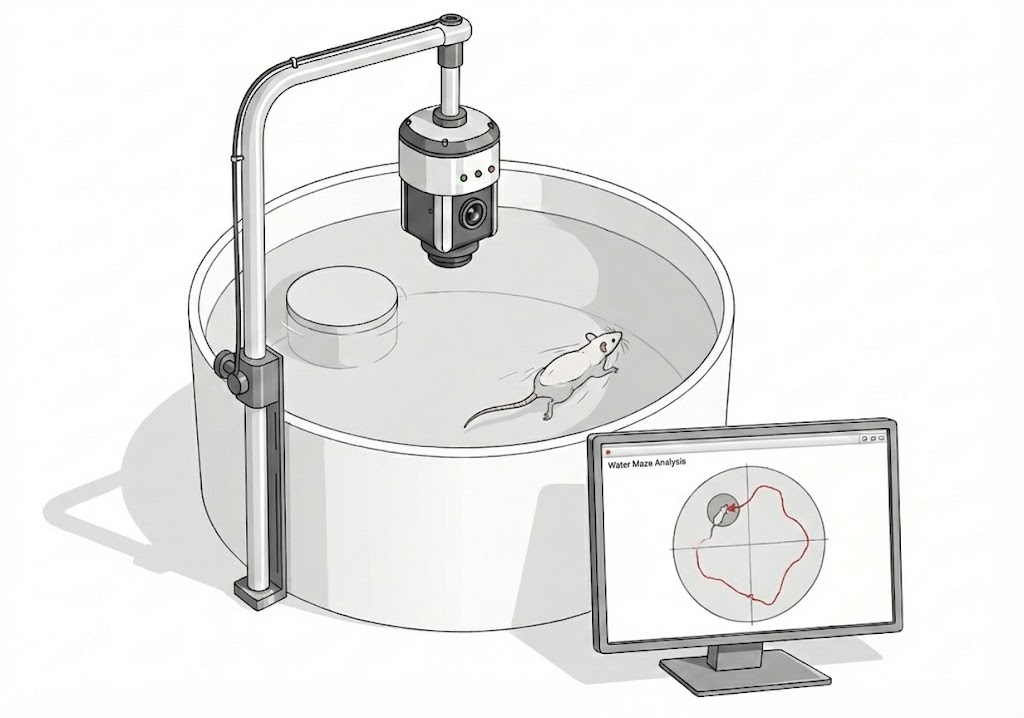
3. Environment Control & Variable Management
3.1 Water Environment Management
- Opacification: Completely hide the platform. Non-toxic, odorless white tempera paint or food-grade titanium dioxide suspension is recommended. Ensure full dissolution to avoid precipitation.
- Temperature Control (Gold Standard: 23°C ± 1°C):
- Low Temperature (<20°C): Induces hypothermia, impairs motor ability, leading to false positives.
- High Temperature (>28°C): Causes "floating behavior," reducing escape motivation.
3.2 Visual Cues & Spatial Geometry
- Cue Types: High-contrast geometric shapes (e.g., black triangles, squares, etc.), size 50-80cm or larger.
- Placement Principles: Fixed on surrounding walls, 0.5-1 meter from the edge. Ensure panoramic coverage (North, South, East, West).
- Constancy: Must absolutely not be moved during the entire experiment period, otherwise, the cognitive map will be reconstructed.
- Masking Interference: Suggest using curtains to separate laboratory background.
3.3 Lighting & Noise
Light Intensity: Recommend 30 Lux - 100 Lux (indirect soft light). Avoid bright light (>400 Lux), especially for albino mice, as it causes anxiety.
Noise Control: Maintain absolute silence. A white noise generator (~60dB) is recommended to mask sudden noises.
4. Animal Preparation & Ethics
- Strain: C57BL/6 mice are preferred (good vision). Albino strains (like BALB/c) should be used with caution. Lister Hooded rats are recommended.
- Sex: Both sexes can be used. Female estrous cycles may affect results, so test in batches and clean thoroughly to remove odors.
- Age: Adult animals aged 8-12 weeks are recommended.
- Handling: Handle for 1-2 minutes daily for 3-5 days before the experiment to reduce stress.
- Circadian Rhythm: Perform at the same time of the light cycle (e.g., 3 hours after lights on).
5. Standard Procedure
5.1 Phase 1: Adaptation & Visible Platform Training (Days 0-1)
Acclimate animals to the water environment and rule out visual or motor deficits.
- Setup: Platform exposed 1cm above water or flagged.
- Procedure: 4 trials, platform position changes randomly. Search time limited to 60s; if found or guided, stay for 15s.
- Purpose: Prevent spatial preference formation and ensure use of vision to find the flag.
5.2 Phase 2: Hidden Platform Acquisition Training (Days 2-6)
Core experiment, assessing spatial learning ability.
- Setup: Platform fixed (e.g., NE quadrant), submerged 0.5-1.5cm. Water opaque.
- Schedule: 4 trials per day for 4-6 consecutive days.
- Entry Points: 4 different entry points per day, following a pseudorandom sequence (avoiding consecutive same positions, including far and near points).
- Operation: Release facing the wall. Time limit 60s (mouse)/90s (rat). Whether found or not, must stay on platform for 15-30s (consolidation).
5.3 Phase 3: Probe Trial (Day 7)
Assess memory strength and precision. Usually performed 24 hours after the last training session.
- Setup: Remove platform.
- Procedure: Release from the furthest entry point, free swim for 30-60s.
- Note: Duration should not be too long to prevent "extinction learning".
5.4 Phase 4: Reversal Learning (Optional)
Assess cognitive flexibility. Move platform to the opposite quadrant and repeat acquisition training for 3-5 days.
6. Post-experiment Care & Cleaning
6.1 Drying & Rewarming
- Towel Dry: Dry immediately after each trial.
- Infrared Heating Lamp/Pad: ~37°C. Warning: Lamp should only cover half the cage, leaving a cool area to prevent overheating.
- Prevent Hypothermia: Never return wet animals to home cages.
6.2 Hygiene & Cleaning
- Remove Debris: Feces must be scooped out after each trial to prevent video interference and pheromone release.
- Water Change: Change water every 3-5 days depending on condition, monitor water quality.
7. Data Analysis & Key Metrics
7.2 Probe Trial Metrics (Gold Standard for Memory)
Percentage of time spent in the quadrant where the platform was located.
Significantly > chance (25%) = Good Memory
Number of times crossing the exact location of the former platform.
Reflects localization precision
Average distance of the animal from the platform center in each frame.
Most sensitive metric
7.3 Search Strategy Qualitative Analysis
- Thigmotaxis: Swimming along the wall (High anxiety / Learning failure).
- Random Search: Disordered trajectory covering the whole pool (Early exploration).
- Scanning: Wide-range search in the center area.
- Chaining: Swimming in a circle at the platform radius (Egocentric strategy).
- Direct Path: Swimming straight to the platform (Perfect allocentric map).
8. Troubleshooting
Animal swims along the wall constantly
Cause: Anxiety, light too bright, water too cold. Solution: Dim lights, handle more, check water temperature.
Animal floats immobile
Cause: Despair, water too hot, exhaustion. Solution: Cool water to 23°C, gently touch tail, exclude severely floating individuals.
Video tracking loss
Cause: Reflection, low contrast. Solution: Use polarizing filter, adjust aperture, white paint for black mice.
Behavior-Metrics
AI Analysis Platform
Smart tracking for Open Field, Water Maze & more
Automate analysis for OFT, MWM, and complex behaviors. Join now to get 1 Year Pro Plan for free.
Limited time offer for early adopters.