
Three-Chamber Social Test
The Gold Standard for Assessing Sociability and Social Novelty Preference
Introduction
The Three-Chamber Social Test, also known as Crawley’s Three-Chamber Test, is the standard paradigm for quantifying social deficits in rodent models of Autism Spectrum Disorder (ASD), Schizophrenia, and other neuropsychiatric conditions.
It exploits two innate tendencies of rodents:
1. Sociability: The drive to explore a conspecific (social stimulus) over an empty object.
2. Social Novelty: The preference for a novel stranger over a familiar conspecific (social memory).
Apparatus & Engineering
Chamber Dimensions
The apparatus consists of three linearly arranged rectangular compartments separated by clear walls with openable doors.
| Parameter | Mouse | Rat |
|---|---|---|
| Total Size (L×W×H) | 60 × 40 × 22 cm | 120 × 40-80 × 40 cm |
| Single Chamber | 20 × 40 cm | 40 × 40 cm |
| Wire Cup Diameter | 7 - 10 cm | 15 - 22 cm |
| Bar Spacing (Critical) | 7 - 10 mm | 10 - 14 mm |
Equipment Setup
- Wire Cups:Cylindrical wire cages to contain stimulus animals. Must permit visual, olfactory, and auditory interaction but prevent physical contact/fighting. Weighted tops prevent tipping.
- Lighting:Low, even illumination (5-20 Lux). Uneven lighting causes side bias.
- Background:White noise (60-65 dB) to mask external sounds.
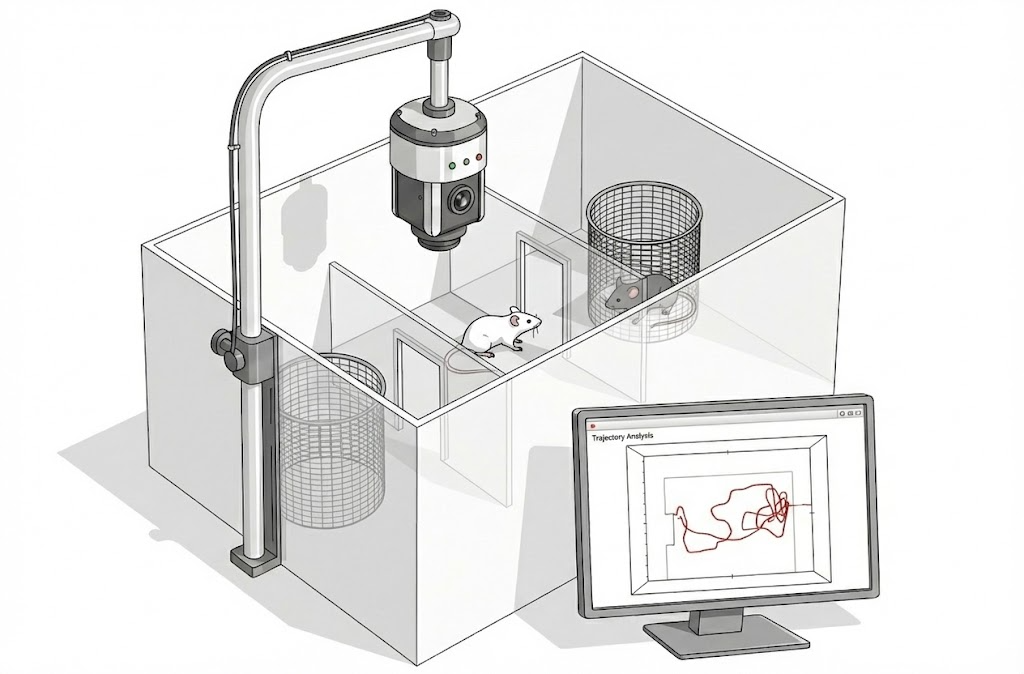
Preparation
Stimulus Animals (Strangers)
- Match: Same sex, age, and weight as subject.
- Strain: Docile strain (e.g., 129/SvImJ) to reduce aggression.
- Habituation: MUST be habituated to wire cups (15-20 mins/day for 3-5 days) to remain calm during testing.
Subject Animals
- Isolation: Social isolation prior to test increases social motivation (protocol dependent).
- Acclimatization: 30-60 mins in testing room.
Standard 3-Phase Procedure
Phase 1: Habituation (5-10 min)
Place subject in center. Allow free access to all 3 chambers. Empty wire cups are present in side chambers.
Phase 2: Sociability (10 min)
Confine subject to center. Place Stranger 1 in one cup and an Object in the other. Open doors. Measure time spent sniffing each cup.
Note: Counterbalance location of Stranger 1 across subjects.
Phase 3: Social Novelty (10 min)
Replace Object with a new Stranger 2. Stranger 1 remains. Open doors. Measure preference for Novel vs. Familiar.
Data Analysis
Sociability Index (SI)
- Positive (>0): Preference for social target.
- Negative/Zero: Social avoidance or lack of interest.
- Normal Range: 0.2 - 0.6 for WT mice.
Social Novelty Index (SNI)
- Positive (>0): Intact social memory.
- Zero: Failure to recognize familiar conspecific.
Troubleshooting
Aggressive Stimulus Mouse
If the stranger mouse is aggressive or biting the bars, the subject will avoid it due to fear, not social deficits. Solution: Use docile strains (129) and ensure proper habituation.
Side Bias
Subject stays in one chamber during habituation. Solution: Check lighting uniformity (<2 Lux difference) and clean thoroughly with ethanol to remove odor cues.