
Elevated Plus Maze (EPM)
The Gold Standard for Screening Anxiolytic/Anxiogenic Compounds
Introduction
The Elevated Plus Maze (EPM) was validated by Pellow et al. (1985) and has since become the most widely used test for anxiety-like behavior. It relies on the rodent's innate "Approach-Avoidance Conflict": the drive to explore novel environments versus the fear of open, elevated, and illuminated spaces (acrophobia/agoraphobia).
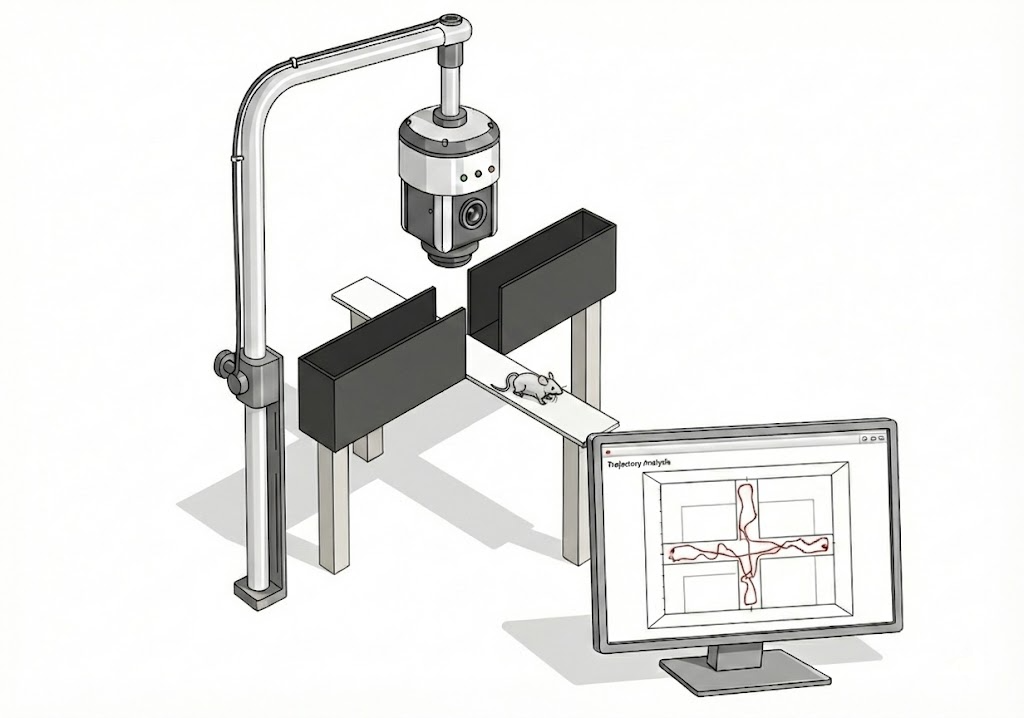
The maze consists of two open arms (threatening) and two enclosed arms (safe) crossed in the middle. Anxiolytic drugs (e.g., Diazepam) increase open arm exploration, while anxiogenic agents reduce it. Unlike conditioned fear tests, EPM requires no training or food deprivation, making it a rapid and ecologically valid screen.
Apparatus & Environment
2.1 Maze Dimensions
The maze is elevated above the floor. It has four arms: two Open Arms (OA) and two Closed Arms (CA) with high walls. Material should be matte (non-reflective).
| Component | Mouse Dimensions | Rat Dimensions |
|---|---|---|
| Arm Length | 30 cm | 50 cm |
| Arm Width | 5 cm | 10 cm |
| Wall Height (Closed) | 15 cm | 40 cm |
| Elevation from Floor | 40 - 50 cm | 50 - 70 cm |
Critical Environmental Controls
- Lighting:Crucial variable. Standard: 30-100 Lux on Open Arms.Too dark = Ceiling effect (all explore). Too bright = Floor effect (all hide). Uniformity is key.
- Visuals:Use black curtains to hide room cues. EPM is NOT a spatial test; avoid external landmarks that might guide navigation.
- Noise:White noise (60-65 dB) recommended to mask sudden sounds that cause freezing.
Preparation
Handling
Essential. Handle animals 1-2 mins/day for 3-5 days prior.
Unhandled animals react to the experimenter with acute stress, masking true anxiety levels.
"One-Trial Tolerance"
EPM should generally be used as a single-exposure test.
Upon 2nd exposure, animals "learn" the open arms have no escape and avoid them drastically (Learned Fear), rendering data invalid.
Procedure Steps
1. Cleaning
Wipe entire maze with 70% alcohol (or 1% acetic acid) and dry completely. Scent of previous animal alters behavior significantly.
2. Placement
Place animal in the Central Platform, facing an Open Arm.
Note: Facing the open arm ensures immediate exposure to the "threat", initiating the conflict.
3. Recording
Record for 5 minutes. Retreat from view immediately.
4. Removal
Remove animal and place in temporary holding cage (separate from untested animals).
Key Results & Interpretation
5.1 Anxiety Indices
Lower values indicate higher anxiety.
- % Time in Open ArmsMore = Less Anxious
Time in OA / Total Time * 100.
- % Entries into Open ArmsMore = Less Anxious
OA Entries / (OA Entries + CA Entries) * 100.
- Risk AssessmentMore = High Conflict
Head dips (protected/unprotected) and Stretch-attend postures.
5.2 Locomotor Control
Crucial to distinguish anxiety from sedation.
- Closed Arm EntriesActivity Metric
Since CA is safe, entries here reflect pure motor drive. If Drug X reduces OA time but also reduces CA entries, it's likely a sedative, not anxiogenic.
- Total Distance
Total path length in all arms.
Common Issues
Floor Effect (Low OA Time in Controls)
Light too bright? Noise too loud? Animal strain too anxious (e.g., BALB/c)? Hard to detect anxiogenic drugs.
Ceiling Effect (High OA Time in Controls)
Light too dim? Maze walls too high/safe? Hard to detect anxiolytic drugs.
Falls
Maze ledges may be needed (small 3-5mm lip) if ataxia is present, but this alters anxiety baseline.