
Novel Object Recognition (NOR)
Assessing Recognition Memory through Spontaneous Preference for Novelty
Introduction
The Novel Object Recognition (NOR) test, developed by Ennaceur and Delacour (1988), relies on the innate tendency of rodents to spend more time exploring a novel object than a familiar one.
This task evaluates recognition memory. Because it does not require negative reinforcement (like electric shock) or food deprivation, it is considered a high-ecological-validity test for assessing cognitive deficits in models of Alzheimer's disease, schizophrenia, and aging.
Apparatus & Objects
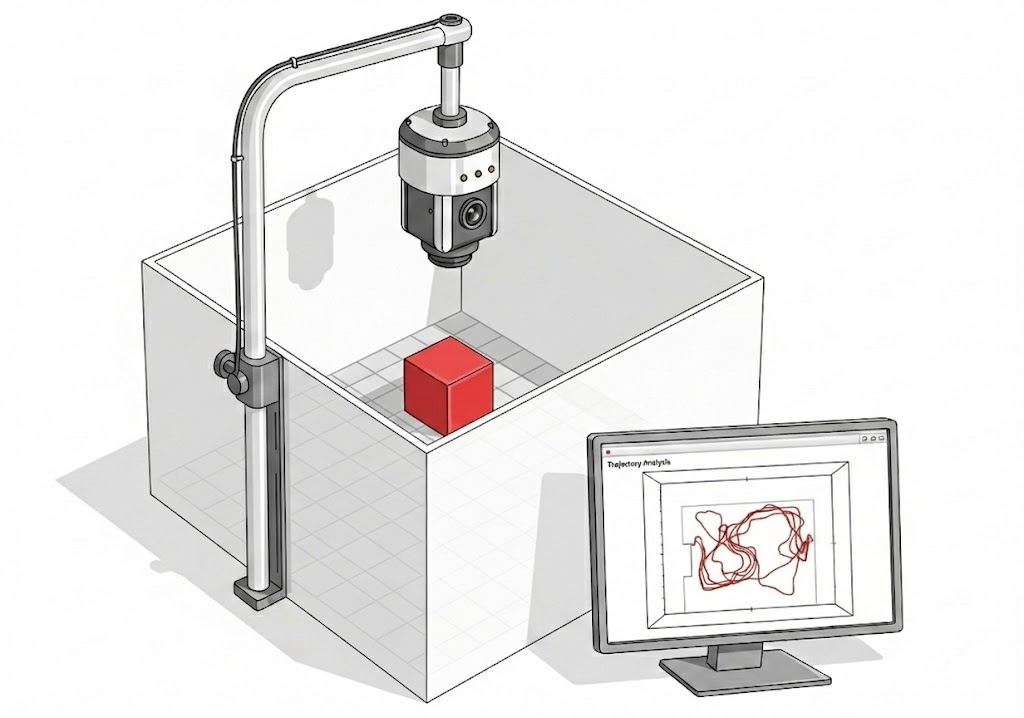
The Arena (Open Field)
- Mouse: 40cm × 40cm × 35cm
- Rat: 60cm × 60cm × 40cm
- Color: High contrast to animal (Black/Grey for white mice).
- Lighting: Dim (20-50 Lux) to encourage exploration.
The Objects
- Material: Glass, metal, or hard plastic (easy to clean, non-porous).
- Stability: Heavy or fixed to floor (Velcro) so animals can't move them.
- Affordance: No flat tops (prevents sitting). Distinct shapes and textures.
- Validation: Must have no natural preference in pilot studies.
Protocol Phases
Phase 1: Habituation
Day 1-2
Allow animals to freely explore the empty arena for 10 minutes per day for 2-3 days. This reduces anxiety induced by the new environment.
Phase 2: Familiarization (Training)
Day 3 (T1)
Place two identical objects (A1 + A2) in the arena. Allow animal to explore for 5-10 minutes.
Criterion: Total exploration time must exceed 20s.
Retention Interval
Phase 3: Test
Day 3 or 4 (T2)
Replace one familiar object with a Novel Object (B). Place a fresh copy of the familiar object (A3) to avoid scent cues.
Allow exploration for 5 minutes.
Analysis: Discrimination Index (DI)
DI > 0
Normal Memory
Prefers Novel Object
DI ≈ 0
Memory Deficit / Chance
No Preference
DI < 0
Abnormal / Anxiety
Avoids Novelty
Strict Definition of "Exploration"
- Nose pointing to object within 2 cm.
- Sniffing or touching with nose.
- Excluded: Sitting on object, leaning against it, or looking around while near it.
Troubleshooting
Side Bias
If animal spends >70% time on one side during training, exclude it. Always counterbalance object positions (Left/Right) across the group.
Low Exploration
Ensure objects are interesting (complex shape/texture). Ensure anxiety is low (sufficient habituation).