
Barnes Maze
The Low-Stress Alternative to the Morris Water Maze
Introduction
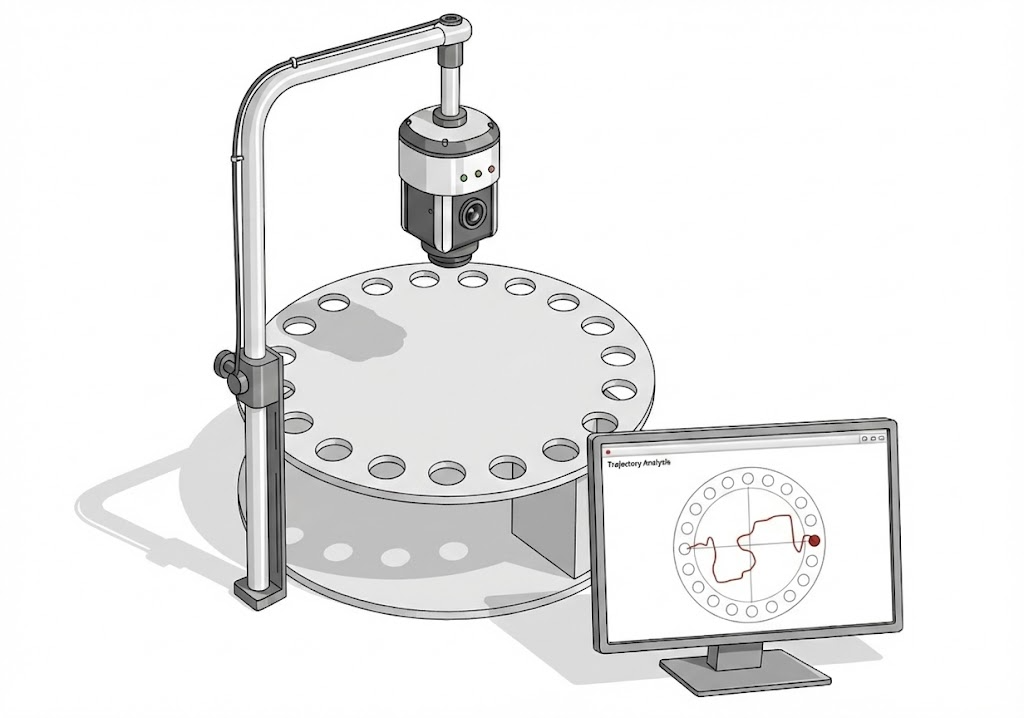
Developed by Carol Barnes in 1979, the Barnes Maze is a spatial navigation task used to assess learning and memory. It consists of a circular platform with holes around the perimeter, one of which leads to a dark "Escape Box".
Unlike the Morris Water Maze (MWM) which uses water stress, the Barnes Maze relies on the rodent's innate aversion to open, bright spaces and loud noise. This makes it ideal for aging research, phenotyping mice with motor deficits, or stress-sensitive strains where swimming might be physically impossible or induce excessive corticosterone levels.
Apparatus & Environment
2.1 Maze Specifications
Circular platform (Grey or White PVC). Grey is preferred for tracking.
| Component | Mouse Dimensions | Rat Dimensions |
|---|---|---|
| Diameter | 91 - 122 cm | 122 cm |
| Number of Holes | 20 (Standard) or 40 | 18 or 20 |
| Hole Diameter | 5 cm | 10 cm |
| Elevation | 90 - 100 cm | 90 - 100 cm |
The Stimuli
Negative Reinforcement
Bright Light: 900-1000 Lux on surface.
Loud Noise: 80-90 dB buzzer/white noise.
Turn ON when trial starts, turn OFF when animal enters box.
Visual Cues
Large, high-contrast shapes on walls 50-100cm away. Must not move throughout the experiment duration.
Preparation
Target Hole Selection
Assign a fixed location for the Escape Box relative to visual cues. Keep constant for acquisition training.
Cleaning
Thoroughly clean maze with 70% ethanol between trials. Rotation: Rotate the maze platform itself (if possible) while keeping the box fixed relative to the room, to rule out floor-scent cues.
Procedure Steps
Adaptation (Day 1)
Goal: Familiarize animal with the maze and the escape box concept.
- Place animal in center cylinder for 10s.
- Gently guide animal to the escape hole. Allow it to enter.
- Cover hole, let animal stay for 2 mins. Return to home cage.
Acquisition Training (Day 1-4)
Goal: Learn spatial location of escape box.
- Start: Place in center cylinder. Remove cylinder, turn ON light/buzzer.
- Search: Allow 3-5 mins to find box.
- Success: If enters box, turn OFF stimuli. Leave for 1 min.
- Fail: If time expires, guide to box. Leave for 1 min.
- Trials: 2-4 trials/day, 15-30 min ITI.
Probe Trial (Day 5)
Goal: Test memory retention (Reference Memory).
- Setup: Remove escape box. Close all holes.
- Run: 60-90 seconds.
- Measure: Time spent in target quadrant; Visits to target hole.
Data Analysis
Primary Metrics
- Primary LatencyLower = Better Learning
Time to first poke head into the TARGET hole.
- ErrorsLower = Better Learning
Reference Error: Checking non-target holes.
Working Error: Re-checking same non-target hole.
Strategy Analysis
Classify search path:
- Spatial:Direct path to target (+/- 2 holes). Indicates hippocampus map.
- Serial:Checking holes in sequence (1, 2, 3...). Non-spatial strategy.
- Random:Chaotic crossing. No strategy.
Troubleshooting
Animal sits in maze / Lack of motivation
Light not bright enough? Buzzer too quiet? Add used bedding to escape box to make it more attractive.
Animal finds hole but won't enter
Common issue. Record "Primary Latency" (head poke) as main metric instead of "Total Latency" (entry).