
Radial Arm Maze (RAM)
The Gold Standard for Dissociating Working Memory and Reference Memory in Rodents
Introduction
The Radial Arm Maze was developed by David S. Olton and Robert J. Samuelson in 1976. Unlike the Open Field Test which relies on approach-avoidance conflict, the RAM is based on the "Win-Shift" foraging strategy evolved in wild rodents. In nature, once a food source is depleted, the optimal strategy is to shift to a new location rather than returning to the same spot.
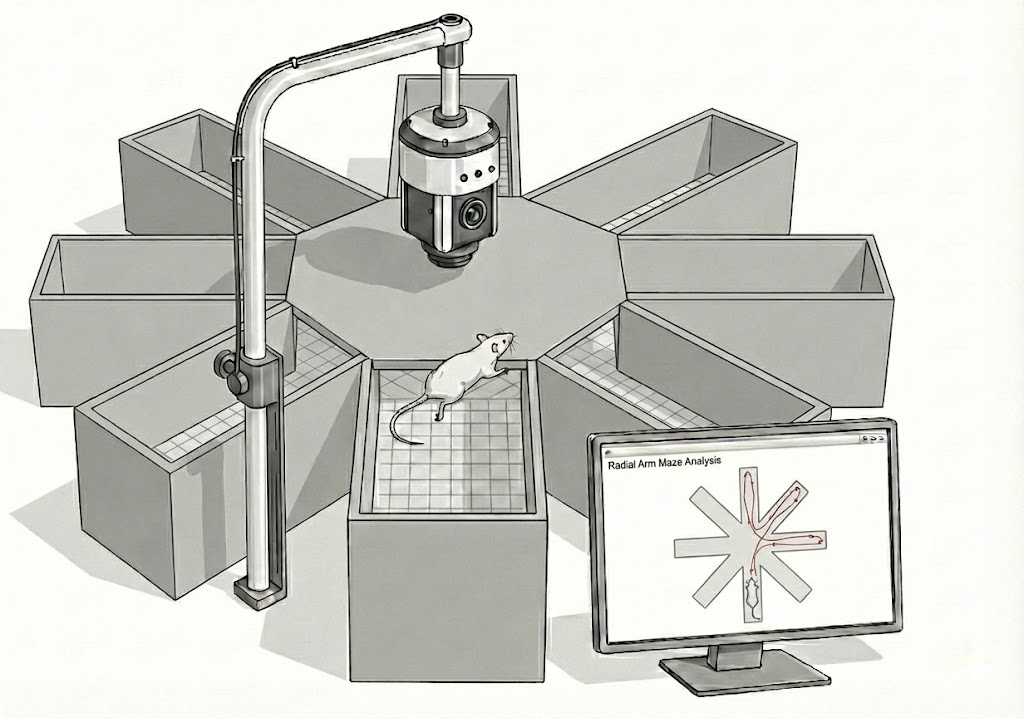
By arranging eight arms radiating from a central platform, the RAM challenges the animal to remember which arms it has already visited (Spatial Working Memory) and which arms never contain food (Spatial Reference Memory). This paradigm is crucial for understanding the hippocampal-prefrontal cortical circuits involved in memory coding, storage, and retrieval.
Purpose
Assess Working Memory
Evaluate the "on-line" memory capacity (7 +/- 2 items). A "Working Memory Error" occurs when an animal re-enters an arm it has already visited in the same trial. This relies heavily on the hippocampus and prefrontal cortex.
Assess Reference Memory
Evaluate long-term rule learning. A "Reference Memory Error" occurs when an animal enters an arm that never contains food (in specific protocols). This reflects long-term consolidation dependent on the hippocampus and cortex.
Apparatus & Configuration
3.1 Maze Specifications
The maze consists of a central octagonal platform with eight arms radiating outward. Material should be matte finish ABS or PVC to prevent reflections. Color should contrast with the animal (Black/Grey for White Rats, White/Grey for C57BL/6 Mice).
| Component | Mouse Dimensions | Rat Dimensions |
|---|---|---|
| Arm Length | 35 - 40 cm | 50 - 60 cm |
| Arm Width | 5 - 6 cm | 10 - 12 cm |
| Central Platform | 20 - 30 cm diameter | 30 - 40 cm diameter |
| Elevation | 40 - 50 cm | 50 - 70 cm |
Critical Environmental Controls
- Visual Cues:High-contrast geometric shapes (Triangle, Circle, etc.) must be placed on walls 1-2 meters away. These cues must remain absolutely stationary throughout the experiment.
- Intra-maze Cues:Strictly Prohibited. Do not mark the maze arms. Clean thoroughly with 75% alcohol between trials to remove scent trails.
- Lighting:Dim lighting (30-50 Lux) is recommended to reduce anxiety and encourage foraging.
Pre-experimental Preparation
Food Restriction (CRITICAL)
Unlike spontaneous tests, RAM requires motivation. Animals must be hungry to search for food.
- Target Weight: 85% - 90% of free-feeding body weight.
- Start restriction 1 week before testing.
- Feed maintenance diet after daily testing is complete.
Handling & Habituation
- Handling: 3-5 days, 2-5 mins/day to reduce stress.
- Reward Habituation: Place reward pellets (e.g., sucrose pellets, chocolate bits) in home cage to familiarize taste.
- Maze Habituation: Day 1-2 (Group), Day 3-4 (Individual). Scatter food on arms to encourage exploration. Criterion: Animal readily runs to arm ends to eat.
Procedure Protocols
Protocol A: Standard Win-Shift (Working Memory)
Most CommonBaiting
Place one food pellet in the food cup at the end of ALL 8 arms.
Start
Place animal in the center. If using automatic doors, wait 10s before opening. If manual, ensure random orientation.
Run
Animal explores freely. Valid entry = 4 paws inside arm.
Termination
End trial when: a) All 8 pellets eaten, b) 10-15 mins elapsed, or c) High error count (e.g., 20 choices).
Protocol B: Mixed Memory Task (4/8 Baited)
AdvancedBait only 4 specific arms (e.g., 1, 3, 5, 7). Keep this pattern constant for the animal across days.
- Reference Memory Error:Entry into an arm that never has food (e.g., arm 2, 4, 6, 8).
- Working Memory Error:Re-entry into a baited arm that was already visited in this trial.
Key Results & Interpretation
6.1 Cognitive Metrics
- Working Memory ErrorsLower = Better
Re-entries into visited arms. Indicates hippocampal/PFC dysfunction.
- Reference Memory ErrorsLower = Better
Entries into never-baited arms. Indicates failure to learn rules/map.
- First 8 Choices CorrectMax = 8
Number of unique arms visited in the first 8 choices. Chance level is ~5.3.
6.2 Strategy & Control
- Adjacency IndexCheck for Strategy
% of choices where animal enters the adjacent arm (e.g., 1→2→3). High index (>80%) suggests non-spatial "chaining" strategy (striatum-dependent), not spatial memory.
- Average Speed
Distance / Time. Essential to rule out motor deficits or sedation.
Troubleshooting
Animal spins/freezes in center
Check for anxiety (light too bright?). Ensure proper habituation. Check if maze surface is too slippery.
Animal tracks scent (sniffing floor)
Clean more thoroughly. Rotate the maze (but not cues) between trials to dissociate floor cues from spatial cues. "Saturate" the room with food odor.