
Light-Dark Box (LDB)
A classic paradigm utilizing the conflict between exploration and photophobia to assess anxiety.
Introduction
The Light-Dark Box (LDB) test, developed by Crawley and Goodwin (1980), is based on the innate conflict between two drives in rodents: the tendency to explore a novel environment and the aversion to brightly lit open spaces (photophobia).
Anxious animals spend more time in the dark compartment and make fewer transitions. Anxiolytic drugs increase the time spent in the light compartment and the number of transitions.
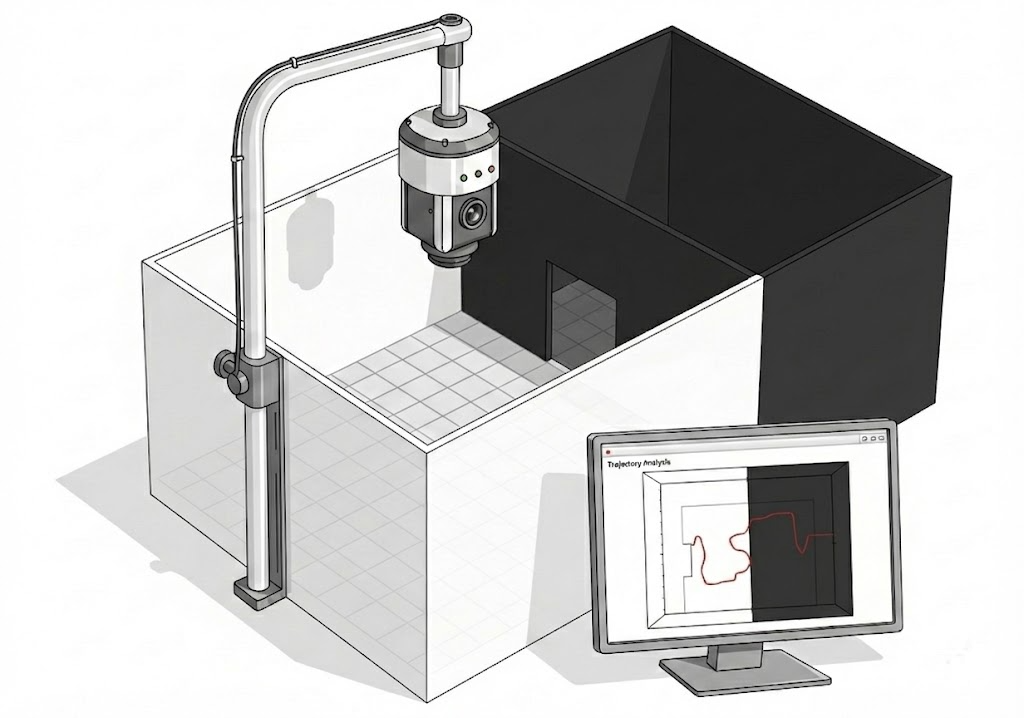
Apparatus
Light Compartment
- Material: Transparent or White Acrylic.
- Illumination: 300 - 500 Lux (Bright).
- Size (Mouse): 20cm × 20cm × 25cm (occupies 1/2 or 2/3 of box).
Dark Compartment
- Material: Black IR-transparent Acrylic.
- Illumination: < 5 Lux (Dark).
- Size (Mouse): 20cm × 20cm × 25cm (occupies 1/3 or 1/2 of box).
Preparation
- Acclimatization: 30-60 mins in the testing room.
- Handling: 3-5 days of gentle handling.
- Cleaning: Wipe with 70% ethanol and allow to dry completely. Ethanol smell is aversive.
- Lighting Check: Use a lux meter to verify the gradient (Bright vs Dark).
Procedure
Step 1: Placement
Place the mouse in the Light Compartment, facing away from the dark door.
(Note: Some protocols start in dark, but starting in light induces immediate conflict).
Step 2: Recording
Allow free exploration for 5 - 10 minutes. Start timer immediately upon release.
Step 3: Cleanup
Remove animal, count fecal boli (optional anxiety index), and clean apparatus.
Analysis & Interpretation
Anxiety Indices
- Time in LightDecrease = Anxiety
- TransitionsDecrease = Anxiety
- Latency to DarkShort = High Anxiety
Control Indices
- Total DistanceLocomotion
- Dark Zone DistanceSedation Check
* If drug reduces light time BUT also reduces dark zone movement, it is likely sedative, not anxiogenic.