
Forced Swim Test (FST)
The Porsolt Test: The Gold Standard for Screening Antidepressant Activity
Introduction
The Forced Swim Test, also known as the Porsolt Swim Test, was developed by Roger Porsolt in 1977. It is one of the most widely used behavioral paradigms for screening potential antidepressant compounds in rodents.
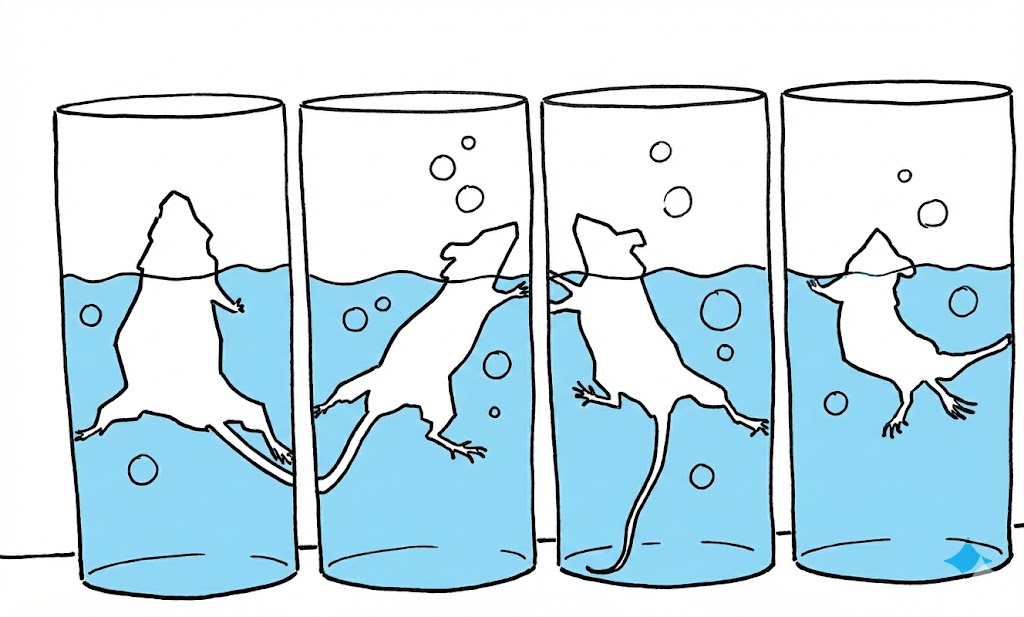
The test is based on the principle of "behavioral despair". When rodents are placed in a confined cylinder of water from which they cannot escape, they initially struggle to escape but eventually develop an immobile posture. This immobility is interpreted as a state of despair or hopelessness, mimicking core symptoms of depression. Antidepressant treatment significantly reduces the duration of this immobility.
Purpose & Model Validity
Predictive Validity
High. The test accurately identifies clinical antidepressants (SSRIs, TCAs, MAOIs). Almost all effective antidepressants reduce immobility time.
Construct Validity
Moderate. While "immobility" parallels psychomotor retardation in depression, modern views also interpret it as an adaptive energy-conserving strategy rather than pure despair.
Apparatus & Environment
2.1 Cylinder Specifications
Transparent Plexiglas or polycarbonate cylinders are recommended. Dimensions are critical to prevent animals from touching the bottom with their tails (which induces false immobility).
| Parameter | Mouse | Rat |
|---|---|---|
| Height | 25 - 30 cm | 40 - 60 cm |
| Diameter | 10 - 15 cm | 20 - 30 cm |
| Water Depth | 10 - 15 cm (Must not touch bottom) | 30 - 40 cm (Tail must not touch bottom) |
2.2 Critical Environmental Controls
- Water Temperature:23°C - 25°C (Strictly controlled). Cold water (<20°C) causes hypothermia; warm water (>30°C) reduces immobility due to comfort.
- Water Change:Change water for every animal to remove alarm pheromones and urine/feces which can alter behavior.
- Lighting:Dim light (15-30 Lux) is recommended to reduce anxiety. Avoid direct reflection on water surface which interferes with video tracking.
Preparation
- Acclimatization: Move animals to the testing room 30-60 minutes before testing.
- Handling: Gentle handling for 3-5 days prior reduces non-specific stress.
- Drug Administration:
- Acute: 30-60 min before test.
- Sub-acute (Rats): 23-5-1 schedule (23h, 5h, and 1h before test).
Procedure
Mouse Protocol (1-Day)
Placement: Gently lower mouse into water. Do not drop.
Duration: 6 minutes total.
Recording: Record the last 4 minutes. The first 2 minutes are considered habituation.
End: Remove mouse, towel dry, and place in a warmed recovery cage (37°C) until dry.
Rat Protocol (2-Day)
Pre-test (Day 1): Swim for 15 minutes to induce learned helplessness. Dry and return to home cage.
Interval: 24 hours.
Test (Day 2): Swim for 5 minutes. Record entire duration.
End: Remove, dry, and warm.
Key Results & Interpretation
Behavioral Scoring
Immobility
Floating with minimal movement necessary to keep head above water.
Interpretation: Depressive-like behavior / Despair.
Swimming
Active horizontal movement across the cylinder.
Sensitive to: Serotonergic (5-HT) compounds.
Climbing
Vertical movement with forepaws breaking water surface against walls.
Sensitive to: Noradrenergic (NE) compounds.
False Positives
Drugs that increase general locomotor activity (stimulants) can reduce immobility without true antidepressant effect.Always validate with an Open Field Test to rule out hyperactivity.