
Tail Suspension Test (TST)
A highly sensitive, mouse-specific model for assessing behavioral despair and antidepressant efficacy.
Introduction
Developed by Steru et al. (1985), the Tail Suspension Test (TST) is a widely used method for screening antidepressant-like activity in mice. Unlike the Forced Swim Test (FST), TST avoids the risk of hypothermia and is considered less stressful.
Species Specificity Warning
The TST is strictly for MICE ONLY. It should NOT be used for rats due to their weight (risk of tail injury) and different behavioral coping strategies (tail climbing).
Apparatus
Box Dimensions & Setup
- Height55 cm
- Width (per compartment)15 cm
- Depth11.5 - 15 cm
- Suspension Height20 - 25 cm (nose to floor)
Background Contrast
Use Black/Grey box for white mice (BALB/c) and White/Grey box for black mice (C57BL/6) to ensure accurate video tracking.
Tail Climber Prevention
For C57BL/6 mice, use hollow polycarbonate tubing (4cm length) over the tail to prevent tail climbing.
Standard Procedure
Tape Preparation
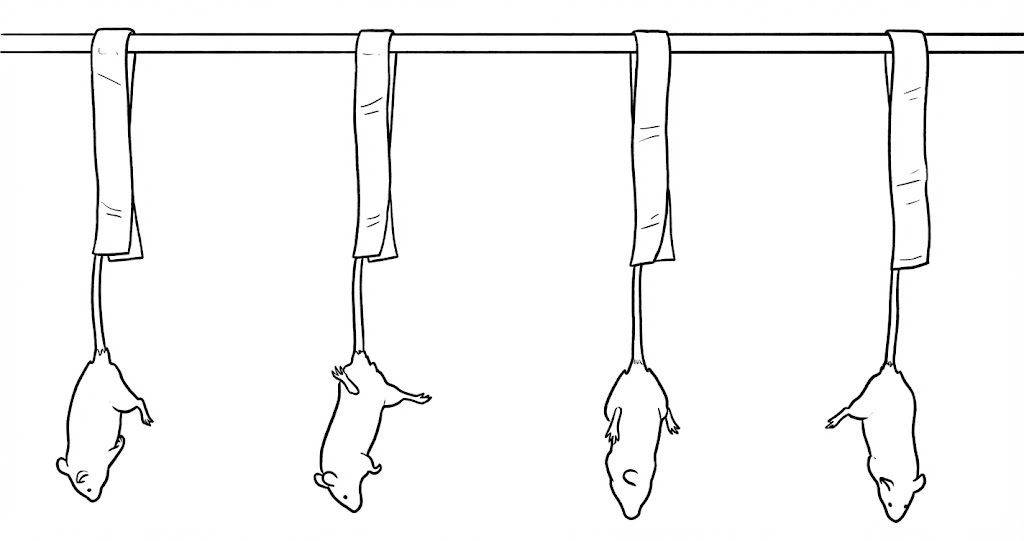
Cut adhesive tape to ~17cm. Mark a line at 2cm from one end. Attach the 2cm section to the mouse's tail tip, leaving 2-3mm gap at the very tip to avoid injury to the tail end.
Suspension
Suspend the mouse by the tape to the suspension bar. Ensure the mouse is vertical and cannot touch the walls. Start recording immediately.
Test Duration
Record for 6 minutes.
Termination
Gently remove the tape from the tail (do not rip). Place mouse in a separate cage. Clean the apparatus with 70% ethanol.
Analysis
Immobility Time
Total time spent completely motionless. Small movements of forepaws are allowed, but struggling/body twisting is not.
Latency to Immobility
Time from start until the first bout of immobility (e.g., >10s).
Troubleshooting
Tail Climbing
If a mouse climbs its tail for >20% of the time, the data is invalid. Use tail tubes for C57BL/6.
Pendulum Effect
After struggling, the mouse may swing like a pendulum. Ensure software thresholds are set to ignore passive swinging as "movement".