
T-Maze Test
A classic paradigm for assessing spatial learning, working memory, and decision-making strategies.
Introduction
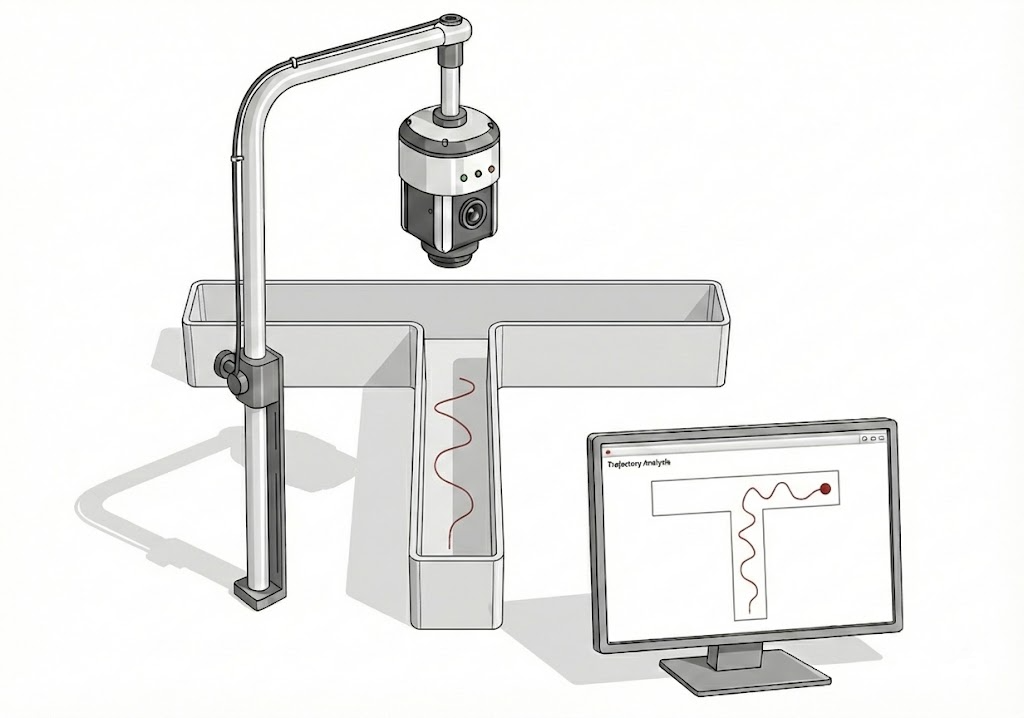
The T-Maze is one of the most widely used and historically significant experimental paradigms in behavioral neuroscience. Named for its "T" shape, it consists of a start arm and two goal arms arranged at 180 degrees, providing a discrete two-choice decision scenario.
Despite its structural simplicity, the T-Maze can reveal complex cognitive functions through various protocols (e.g., Spontaneous Alternation, Rewarded Alternation, Delayed Non-Matching to Sample). Its core validity relies on the "Win-Shift" strategy evolved by rodents to maximize foraging efficiency by exploring novel or previously unvisited locations.
Neural Mechanisms
Hippocampus
Crucial for spatial coding. Place cells construct a cognitive map. Hippocampal lesions severely impair spatial alternation tasks.
Prefrontal Cortex
Essential for working memory. Sustained activity in the mPFC is required to maintain sample information during delays.
Striatum
Involved in habit learning. Control shifts from hippocampus to striatum when tasks become routine (e.g., "always turn left").
Apparatus & Specifications
Standard Dimensions
The maze must allow free turning while restricting vision to focus on goal arms. A central partition at the junction (5-10cm) is recommended to force early decision-making.
| Component | Mouse | Rat |
|---|---|---|
| Start Arm (L × W) | 30-35 cm × 10 cm | 50-70 cm × 15 cm |
| Goal Arms (L × W) | 30 cm × 10 cm | 50-60 cm × 15 cm |
| Wall Height | 15-20 cm | 30-40 cm |
Environmental Control
- Visual Cues:High-contrast geometric shapes placed >1m away. Must remain absolutely static during the experiment.
- Lighting:Low light (10-15 Lux) for spontaneous alternation to reduce anxiety. Moderate light (30-40 Lux) for rewarded tasks. Diffuse lighting to avoid shadows.
- Odor Control:Clean with 50-70% ethanol between trials. For rewarded tasks, saturate the room with food odor to mask target locations.
Preparation & Handling
Animal Handling
- Handling: 3-5 days, 2-5 mins/day prior to experiment.
- Technique: Use "cupping" or tunnel handling. Never pick up by the tail to avoid stress-induced anxiety.
- Acclimatization: Move to testing room 30-60 mins before testing.
Dietary Restriction
- Spontaneous: No restriction needed. Relies on natural exploration.
- Rewarded: Restrict to 85-90% of free-feeding body weight. Start 1 week prior. Habituate to reward pellets in home cage.
Procedure I: Spontaneous Alternation
Used for rapid screening of hippocampal function, phenotyping, and drug screening. No pre-training or fasting required.
1. Sample Trial
Block one goal arm (e.g., Right). Place animal in Start Arm facing away from maze. Allow animal to enter the open Left arm. Close door and confine for 30 seconds to encode spatial memory.
2. Delay Interval
Remove animal to holding cage. Wipe maze with ethanol. Delay can be 5s - 60s for working memory, or longer (mins) for forgetting curves.
3. Choice Trial
Open BOTH arms. Place animal in Start Arm. Record which arm is chosen (4 paws enter).
- Correct: Enters previously blocked arm (Novelty preference).
- Incorrect: Enters previously visited arm.
Procedure II: Rewarded Alternation
For deep assessment of spatial learning and long-term memory. Requires fasting and training.
1. Habituation (Days 1-2)
Scatter rewards in all arms. Allow free exploration for 10-15 mins to reduce fear.
2. Forced Alternation Training (Days 3-10)
Rule: "Food is always in the arm you didn't just visit."
- Forced Run: Block one side, force animal to other side for reward.
- Delay: 10-20s. Wipe maze.
- Choice Run: Open both. Animal must choose the opposite arm to get reward.
3. Testing
Once 80% accuracy is reached, test with longer delays or drug interventions.
Key Metrics
Primary Indices
- Spontaneous Alternation %Norm: 70-80%
(Actual Alternations / Total Trials) × 100. Below 60% suggests dysfunction. Random = 50%.
- Bias IndexTarget: < 0.4
|Left Entries - Right Entries| / Total Entries. High bias indicates motor preference, not memory.
Secondary Metrics
- Decision Latency
Time from start to arm entry. Long latency may indicate anxiety or low motivation.
- Error Types (Rewarded)
Working Memory Error: Re-entering visited arm.
Reference Memory Error: Entering never-baited arm.