
Y-Maze Spontaneous Alternation
A simple yet powerful test for spatial working memory based on the innate exploratory drive of rodents.
Introduction
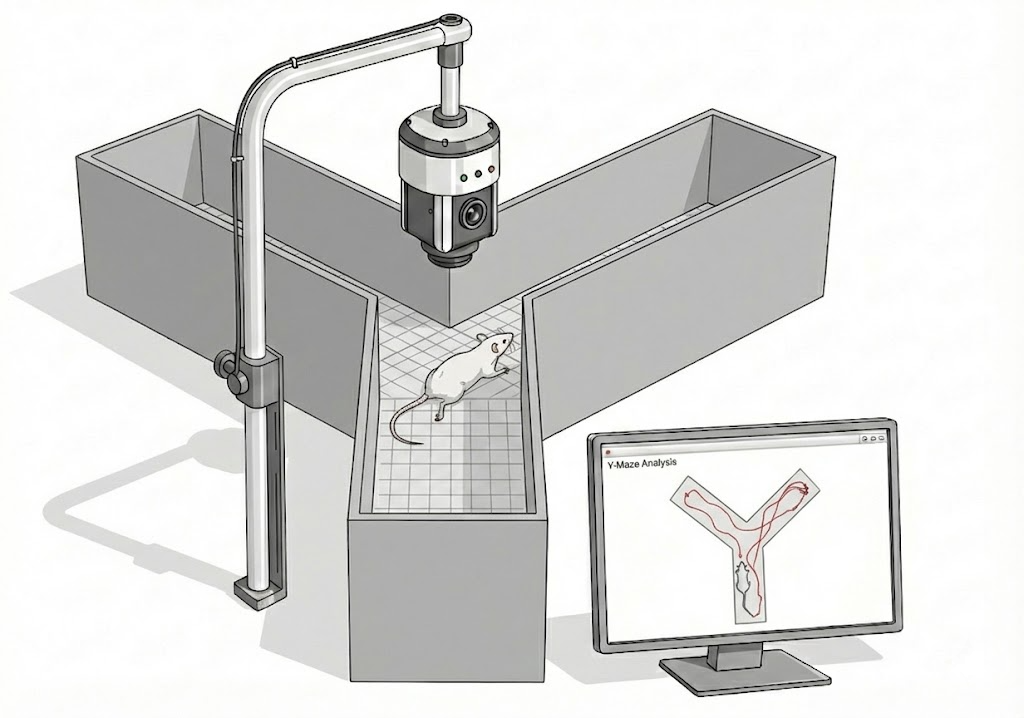
The Y-Maze is a modification of the T-Maze, consisting of three arms spaced 120° apart. It is widely used to assess spatial working memory through spontaneous alternation behavior.
Rodents have an innate tendency to explore novel environments. When placed in a Y-Maze, they typically prefer to enter a new arm rather than returning to the one they just visited. This "alternation" behavior requires the animal to remember which arm it last entered, thus taxing spatial working memory.
Apparatus
Y-Maze Dimensions
The apparatus consists of three identical arms (labeled A, B, C) converging at a central triangle.
| Subject | Arm Length | Arm Width | Wall Height |
|---|---|---|---|
| Mouse | 30 - 40 cm | 5 - 8 cm | 12 - 15 cm |
| Rat | 50 - 60 cm | 10 - 15 cm | 20 - 30 cm |
Preparation
Environment
- Lighting: Dim light (10-30 Lux) to encourage exploration and reduce anxiety.
- Visual Cues: Place distinct visual cues (shapes, posters) on the walls around the maze to aid spatial navigation.
Animal Handling
- Acclimatize animals to the testing room for 30-60 mins.
- Handle gently to minimize stress.
Procedure (Spontaneous Alternation)
1. Start
Place the animal in the center of the maze (or at the end of one arm, designated as Start Arm), facing the wall.
2. Free Exploration
Allow the animal to freely explore all three arms for 5 to 8 minutes.
3. Recording
Record the sequence of arm entries (e.g., A -> B -> C -> A -> B). An entry is usually defined as all four paws entering the arm.
4. Cleaning
Clean the maze with 70% ethanol between animals to remove olfactory cues.
Analysis
Alternation Behavior
- Spontaneous Alternation %Number of TriadsTotal Arm Entries - 2× 100%
A "Triad" is a set of three consecutive choices of three different arms (e.g., ABC, BCA, CAB).
Normal range: 60-70%. Random chance is 50% (for 2 choices) or 22% (strict triad chance, but typically compared to 50% in T-maze logic, in Y-maze it's higher). - Total Arm Entries
Index of locomotor activity. Low entries (< 6-8) make the alternation % unreliable.